
What is an Integrated Automation System (IAS) on a vessel?
An Integrated Automation System (IAS) connects a vessel's machinery and lets the crew monitor and control systems such as power, propulsion, ballast, bilge and cargo from the same operator stations. It works much like the vessel's nervous system: signals from sensors are carried to the logic that decides what to do, and commands are sent back out to the equipment.
Why a vessel needs an IAS
A modern vessel carries equipment from many suppliers, for example engines, generators, batteries, thrusters, pumps, valves and cranes, each typically with its own local controls. But nothing on board happens in isolation. A crane lifting over the side makes the vessel heel, and a large thruster starting up puts a sudden load on the generators.
Without an integrated system, the crew has to tie it all together themselves. The IAS does that job, and gives the crew one consistent picture on the bridge and in the engine control room. For this to work, systems from different suppliers must be able to exchange data in a secure and meaningful way, and the suppliers must be willing to cooperate.
How an IAS works
An IAS follows a simple principle: signals in, decisions, commands out.
Signals in: Like nerve endings, sensors measure values such as temperature, pressure, tank level, speed and power. The IO system (input/output) converts these into data the system can use, and also communicates with other equipment, for example engine control systems.
Decisions: Controllers run the control logic, such as interlocks (a pump that cannot start unless its suction valve is open), start and stop sequences, and alarm limits.
Commands out: The controllers send commands to equipment such as pumps, valves, breakers and motors.
The crew follows and operates everything from the operator stations, for example through system mimics (live graphical views of each system), alarm lists and trends.

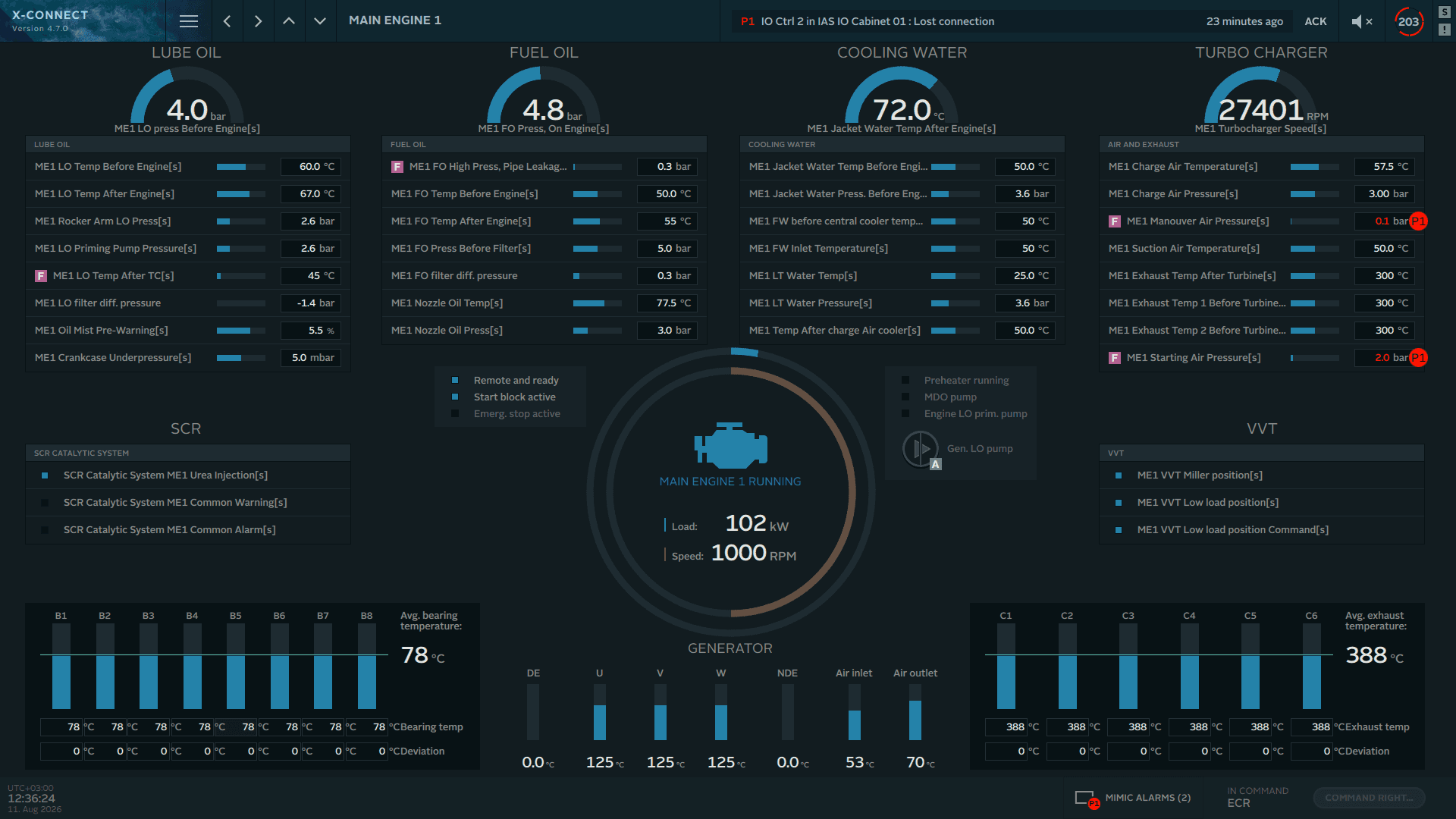


What an IAS does in practice
Keeping the engines running: Before a main engine starts, the IAS can make sure it has lubrication oil and cooling water by starting the right pumps and setting the right valves. While the engine runs, the IAS follows values such as oil pressure and engine temperature, adjusts the cooling accordingly, and lets a standby pump take over if the running pump fails. In the same way, the IAS can keep the fuel service tanks topped up from the storage tanks, so the engines always have fuel.
Keeping the bilges dry: The IAS monitors the water level in the bilge wells and can raise alarms at different levels as the situation develops. In some cases, the level alarms can also start bilge pumps and open or close valves automatically.
Making equipment work towards a common goal: Many functions depend on several pieces of equipment working together. An automatic function can, for example, keep the vessel at a given heel, draft or trim. When a crane lifts a heavy load over the side, or cargo and fuel are loaded or consumed, the IAS reads the heel angle, draft and tank levels, and uses several ballast pumps and valves together to move water between tanks until the vessel is back at the set values. If a valve does not confirm that it has opened, the pump is not started, and the crew is alerted. Much like the body coordinates several muscles to perform one movement, the IAS lets separate equipment act as one.
Working with other onboard systems: The IAS is also often connected to systems such as fresh water production, ballast water treatment, HVAC and the fire alarm system.
IAS vs AMS: what is the difference?
An Alarm and Monitoring System (AMS) monitors the vessel and alerts the crew, but it does not control any equipment. An IAS includes everything an AMS does and adds control and automation. Put simply, the AMS tells you what is happening. The IAS can also do something about it.
Take a ballast tank that is being filled. With an AMS, the crew sees the level on screen and gets a high-level alarm when the tank is nearly full, and someone goes to a local panel to stop the pump and close the valve. With an IAS, the operator starts and stops the pump from the same screen that shows the level, and the system can stop it automatically at the set level or refuse to start it if a valve is closed.
Controlling equipment comes with higher requirements than monitoring it. When an IAS controls safety-critical systems, class rules require that a single failure can only affect a limited part of the vessel. An IAS is therefore usually divided into segments with their own controllers and IO, connected through two separate networks. An AMS can often be built simpler and less expensive, but it is not suited for controlling critical equipment.
Which one a vessel needs depends on factors such as how much should be operated from the bridge or engine control room, how complex the operations are and what class requires. With X‑CONNECT®, the choice does not have to be final. A vessel can start with an AMS and grow into an IAS later, by adding control functions in the configuration and extending the hardware where needed, without replacing the system.
How the X‑CONNECT® IAS is built for the ship owner
Two automation systems can look the same on a datasheet and still behave very differently over 20 to 30 years at sea. For a ship owner, much of the cost of automation comes after delivery, and the X‑CONNECT® IAS is built with that in mind.
Built to work with other suppliers: X‑CONNECT® integrates with equipment and systems from other suppliers over standard interfaces, so the vessel is not tied to one supplier’s ecosystem to get everything to work together.
Configured, not programmed: Much vessel automation is still engineered to order, with control software written or heavily adapted for each vessel, so later changes depend on the people who wrote it. X‑CONNECT® is configure to order. The vessel is still unique, but the building blocks are not. Standard, tested components such as pumps, valves, tanks and generators are configured in X‑CONNECT® Studio instead of being programmed, and the whole system is described in one configuration file. Sister vessels get identical systems, and later changes are made in the configuration rather than in someone’s code.
Distributed, not central: The work is spread across independent controllers that share data through DDS, an open industry standard, so there is no central unit that everything depends on. If one controller fails, the rest of the vessel continues to operate.
Hardware you can get hold of: Controllers and operator stations run on off-the-shelf, marine type-approved hardware that is available worldwide.
Software that keeps moving: X‑CONNECT® is in continuous development, with upgrade options and backward compatibility, so vessels already in operation can benefit from new functions. X‑CONNECT® is delivered and supported through a global network of partners.
What the X‑CONNECT® IAS gives the ship owner
Safety: Built-in interlocks and fewer manual steps reduce the risk of wrong operation, and playback of alarms, events and operator actions helps explain what happened after an incident. The X‑CONNECT® IAS holds DNV type approval for Cyber Security Essential (SP1), in line with IACS UR E26 and E27.
Operational reliability: Segmentation keeps a single failure contained, the system monitors itself and tells the crew where a fault is, and with spare parts on board the crew can often restore operation without waiting for a service engineer.
Savings: Remote diagnostics and over-the-air software updates reduce the need for service visits on board, and because the system is configured rather than programmed, later changes take less time and cost less.
Modernity: New functions and security updates can be installed through software updates, so the vessel is not stuck with the technology it had on delivery day.
What it gives the system integrator
One engineer can configure a complete system in one tool, without writing code, and reuse configurations and customised components on the next project. Tested building blocks mean less new code to debug on site and a more predictable commissioning. Alarm lists, signal lists and the bill of materials, as well as the product lifecycle management (PLM) register, are generated from the configuration, and much of the cyber security assessment is already covered by the DNV type approval.
In short
An AMS watches and warns. An IAS also acts, and makes a vessel's systems work as one. How it is built decides how safe, reliable and costly it will be over the vessel's lifetime, and whether it can be kept up to date for as long as the vessel is in operation.


" height="94.82229999999998px" id="eYkr8_NCT" transform="translate(226.1 37.938)" width="57.37500000000003px"/><path d="M 0 58.092 L 0 0 L 19.863 0 L 19.863 60.045 C 19.863 67.6 21.057 73.005 23.445 76.261 C 25.833 79.517 29.133 81.146 33.344 81.146 C 37.512 81.146 40.769 79.517 43.113 76.261 C 45.501 72.962 46.695 67.556 46.695 60.045 L 46.695 0 L 66.037 0 L 66.037 58.092 C 66.167 70.986 63.324 80.559 57.506 86.811 C 51.688 93.02 43.612 96.124 33.279 96.124 C 22.772 96.124 14.588 93.02 8.727 86.811 C 2.909 80.559 0 70.986 0 58.092 Z" fill="rgb(255, 255, 255)" height="96.1243px" id="ExeemQW43" transform="translate(143.07 37.938)" width="66.04126334943135px"/><path d="M 0 94.822 L 0 0 L 19.928 0 L 19.928 78.41 L 54.315 78.41 L 54.315 94.822 Z" fill="rgb(255, 255, 255)" height="94.82229999999998px" id="eg7ZGwltM" transform="translate(77.943 37.938)" width="54.31460000000001px"/><path d="M 0 94.822 L 0 0 L 34.126 0 C 43.243 0 50.038 2.041 54.51 6.122 C 58.982 10.16 61.218 16.086 61.218 23.901 C 61.218 29.415 60.219 34.017 58.222 37.707 C 56.225 41.398 53.533 43.786 50.146 44.871 L 50.146 45.132 C 54.401 46.217 57.831 48.735 60.436 52.686 C 63.084 56.637 64.409 61.977 64.409 68.707 C 64.409 76.912 61.891 83.316 56.854 87.919 C 51.818 92.521 44.806 94.822 35.819 94.822 Z M 19.603 80.755 L 32.172 80.755 C 36.296 80.755 39.357 79.517 41.354 77.043 C 43.352 74.568 44.35 71.116 44.35 66.688 C 44.35 62.303 43.352 58.808 41.354 56.203 C 39.357 53.555 36.296 52.23 32.172 52.23 L 19.603 52.23 Z M 19.603 40.247 L 30.609 40.247 C 34.647 40.247 37.555 39.118 39.336 36.861 C 41.116 34.603 42.006 31.369 42.006 27.157 C 42.006 22.989 41.116 19.841 39.336 17.714 C 37.555 15.587 34.647 14.501 30.609 14.458 L 19.603 14.458 Z" fill="rgb(255, 255, 255)" height="94.82229999999998px" id="S1V9w4U1k" transform="translate(0 37.938)" width="64.4087px"/><path d="M 0 0 L 20 0 L 20 172 L 0 172 Z" fill="rgb(85, 187, 218)" height="172.00000524521px" id="Id4GQS3Bu" transform="translate(337.475 0)" width="20px"/><path d="M 0 94.822 L 0 0 L 19.928 0 L 19.928 78.41 L 54.314 78.41 L 54.314 94.822 Z" fill="rgb(255, 255, 255)" height="94.82229999999998px" id="b5xSiaJyQ" transform="translate(650.662 38.622)" width="54.313999999999965px"/><path d="M 33.8 0 C 43.135 0 50.429 2.757 55.682 8.271 C 60.935 13.784 63.563 21.035 63.563 30.023 C 63.563 39.183 60.827 46.629 55.357 52.36 C 53.462 54.361 51.344 56.011 49.005 57.313 L 67.405 94.822 L 45.132 94.822 L 29.896 60.957 L 19.929 60.957 L 19.929 94.822 L 0 94.822 L 0 0 Z M 19.929 46.564 L 30.544 46.564 C 35.19 46.564 38.511 45.11 40.508 42.201 C 42.549 39.249 43.569 35.471 43.569 30.869 C 43.569 26.224 42.549 22.468 40.508 19.603 C 38.511 16.737 35.19 15.305 30.544 15.305 L 19.929 15.305 Z" fill="rgb(255, 255, 255)" height="94.82229999999998px" id="mmBGNdmSy" transform="translate(572.689 38.622)" width="67.40500000000009px"/><path d="M 0 16.412 L 0 0 L 68.772 0 L 68.772 16.412 L 44.48 16.412 L 44.48 94.822 L 24.357 94.822 L 24.357 16.412 Z" fill="rgb(255, 255, 255)" height="94.82229999999998px" id="R004O34sn" transform="translate(491.957 38.622)" width="68.77200000000005px"/><path d="M 0 51.253 L 0 46.174 C 0 29.806 3.581 18.018 10.745 10.811 C 17.909 3.604 26.94 0 37.837 0 C 48.822 0 57.136 2.496 62.78 7.489 C 68.424 12.439 71.464 20.775 71.898 32.497 L 71.963 37.251 L 52.425 37.251 L 52.425 31.26 C 52.208 25.703 50.862 21.621 48.388 19.017 C 45.956 16.368 42.526 15.044 38.098 15.044 C 32.454 15.044 28.199 17.193 25.333 21.491 C 22.468 25.746 21.035 32.671 21.035 42.266 L 21.035 55.226 C 21.035 65.559 22.533 72.701 25.529 76.652 C 28.568 80.56 32.844 82.513 38.358 82.513 C 43.047 82.513 46.629 81.059 49.104 78.15 C 51.622 75.241 52.729 70.986 52.425 65.386 L 52.425 60.371 L 71.963 60.371 L 71.963 66.102 C 72.223 76.565 69.293 84.402 63.171 89.612 C 57.049 94.779 48.583 97.362 37.772 97.362 C 26.18 97.362 16.976 93.693 10.159 86.356 C 3.386 79.018 0 67.318 0 51.253 Z" fill="rgb(255, 255, 255)" height="97.36200000000001px" id="D1T8kV_fL" transform="translate(411.475 37.319)" width="71.97889328157117px"/></svg>)
